It's not that people cannot think mathematically. It's that they have enormous trouble doing it in a de-contextualized, abstract setting.
-- Keith Devlin
From In Math You Have to Remember, In Other Subjects You Can Think About It
In 2008 I commenced a coursework Masters in mathematics at the University of Queensland. I have downgraded this to a Graduate Diploma and should officially graduate in a few weeks.
My original goal for commencing postgraduate study was to improve my knowledge in programming languages and make the current research more accessible. Unfortunately the local universities teach very little (relevant) theoretical computing science, so I enrolled in mathematics with a focus on discrete mathematics, logic and abstract algebra. After the first year I discovered that there is no real future in programming language research here in Brisbane. I had achieved my goal in the context of the courses available and so switched my study to statistics as data analytics is both interesting and hopefully more viable locally.
To complete the Masters I need to do the equivalent of four courses in research. As I am enrolled in a coursework masters, I pay 2-3 times the standard undergraduate fees. The last course cost $2010. Therefore there is approximately $8000 in fees remaining.
I would enjoy the remaining Masters research component if could find the right supervisor and topic. However employment as a researcher now generally requires a PhD, not a Masters and while a PhD is longer, it also has no fees. So if the circumstances were right to do the Masters research it makes more sense to consider a PhD anyway.
The value proposition for completing the Masters is too low. I have fulfilled the requirements for a Graduate Diploma and so will finish with that.
After further consideration on Embedding LaTeX in Blogger I have the following concerns in using jsLaTeX.
img alt attribute.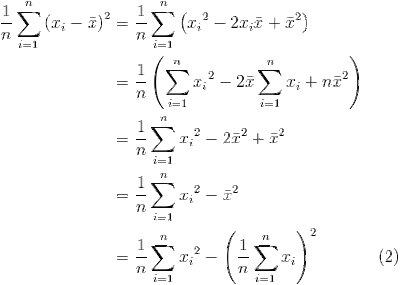
Given a list of n numbers  , the variance is defined as

where  is the arithmetic mean.

Expression 1 stated in words is the average squared difference of each data point from the mean. Implemented as an algorithm, this requires two passes over the data set. The first to calculate the mean and the second to sum the squared differences.
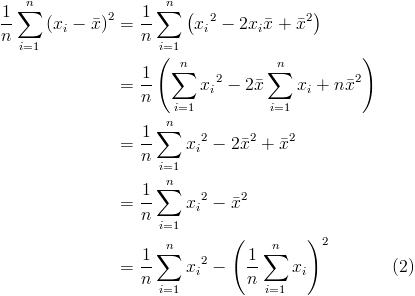
Let's derive the more commonly used expression for variance.
This only requires a single pass over the data set, computing the incremental sum of the values and the incremental sum of their squares. However, if the terms in the subtraction are large and close enough, catastrophic cancellation can occur. Essentially the precision of the floating point representation is exceeded, yielding unacceptable results. See Algorithms for calculating variance and Theoretical explanation for numerical results for examples (they are calculating the sample variance which is slightly different). More detailed information on catastrophic cancellation can be found in What Every Computer Scientist Should Know About Floating Point Arithmetic (1991).
A more numerically stable (but computationally expensive) single pass algorithm was published by Knuth in The Art of Computer Programming, volume 2. Define  and
 as the mean and sum of squared differences of the the first n values respectively.
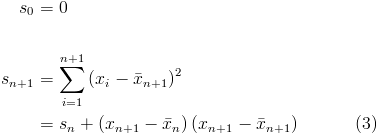
For m > 0 values, the variance is then  .
Derivation of Equation 3
This is really just a more verbose version of one-pass algorithm to compute sample variance. First up is the running mean.
If you think of the mean visually i.e. a horizontal line through the data on a scatter plot, then it is intuitive that the sum of the distances between each point and the mean is zero.
Now define  as the difference of consecutive incremental means, along with a few useful variations.

The pieces are now all in place to derive equation 3.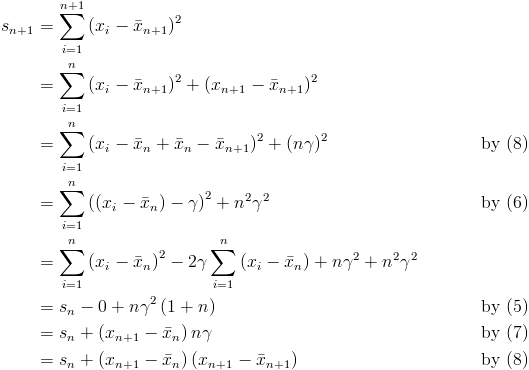
The goal is to include mathematical equations in blog posts. My plan was to create images from the output of MacTeX. Apart from being painfully slow to crop and upload with multiple distinct equations, the LaTeX source would not be contained in the post.
Embedding LaTeX in HTML led me to jsLaTeX. Option 4 from Solutions for JavaScript Hosting in Blogger solved the Blogger hosting issue. After some CSS shenanigans we have Bayes rule right here, right now.
It is easier to write simple equations in the CodeCogs online equation editor first as Blogger preview doesn't seem to execute the JavaScript to render them.
Edit 23/03/2010: No longer using jsLaTeX, see Embedding LaTeX in Blogger take 2.
The role of the proof for mathematics is similar to that for orthography or even calligraphy for poetry. A person, who had not mastered the art of the proofs in high school, is as a rule unable to distinguish correct reasoning from that which is misleading. Such people can be easily manipulated by the irresponsible politicians.
-- V.I. Arnold
My mathematics lecturers often try and introduce a new topic with a motivating example. I think this is a great idea. I am a slow learner and find that an initial concrete example is the best way to approach a new abstract concept. I realise that this can sometimes pose challenges further on, i.e. in generalising from the concrete to the abstract, but this way seems to work the best for me.
Unfortunately, there are many times that the motivating example is not that motivating. I view teaching as often building a bridge from the student's current position to where you want to take them. To achieve that, requires providing an initial high-level context in terms that the student can relate to.
As an example, earlier this year I studied introductory linear algebra that included eigenvectors. Kudos to the lecturer for trying to motivate with a modern example (search engine page rank). Even though I am a professional programmer, this example didn't really work for me and I finished the subject with only a vague idea about them.
Recently I read this article which introduced them with simple physical examples. The second paragraph of the current wikipedia page nicely related it back to matrices and vectors and it all fell into place.
Some mathematical ideas are represented as a sequence of steps, e.g. calculating Maximum Likelihood Estimators in statistics. Once a good motivating example is done to provide context, things can proceed between two extremes.
A few weeks ago I decided to bite the bullet and learn LaTeX. To make it happen I foolishly decided to type up my stats assignment (due yesterday) in it. Made for a very busy week, with my Bris FP talk, work, etc.
Anyway the following sites were useful.
I think the LaTeX support in Zoho Writer's equation editor is a fantastic idea. Although, I don't know what would happen to the LaTeX source when exporting for backup purposes.
UPDATE: Document can be exported as LaTeX.
I ran into the following issues with the equation editor.
Some quotes from The Future of Computing: Logic or Biology, by Leslie Lamport.
Computers interact with users through metaphors. Metaphors are not based on logic, but they are not illogical. Metaphor and logic are not opposites. They are complementary. A good program must use good metaphors, and it must behave logically. The metaphors must be applied consistently—and that means logically.
Floyd and Hoare pointed the way by showing how mathematics could be applied to tiny programs. We need to learn how to extend what they did to the real world of large programs.
Extending what they did does not mean trying to mathematically prove the correctness of million-line programs. It means learning how to apply the idea of a program as a mathematical object to the task of building large programs that we can understand, and that do what we intend them to do.
In addition to the task of learning how to apply mathematics to large systems, we also face the task of teaching programmers and designers to think logically. They must learn how to think about programs as mathematical objects. They must learn to think logically. We will not have understandable programs as long as our universities produce generation after generation of people who, like my former colleagues, cannot understand that programs are different from automobiles.
The names imaginary numbers and real numbers seem a little ironic, given that all maths is imaginary. As an example, consider the number 3. It is not a real thing in the sense that I can't go and observe a three, like I can stone or a tree. It represents the abstraction or concept of threeness, which we have imagined and exists in our minds.
One way to think of maths is as the science of patterns. So we have a huge library of patterns, abstractions, relationships and methods of reasoning about them. When we want to talk about the "real" world, we often draw on this library to give us the vocabulary and tools to do so.
I was thinking about this stuff because I am studying linear algebra at the moment and was reading A Visual, Intuitive Guide to Imaginary Numbers and What is Experimental Mathematics?
I am currently studying axiomatic set theory. In the process I came across Zermelo and Set Theory, which gives details about his work and interactions with other significant mathematicians.
While interesting, it unfortunately didn't help me when working out his proof for the Schroder-Bernstein Theorem in an assignment. :-)
I wanted to have a 
Recently I found the paper Recounting the Rationals via Mark Jason Dominus on Planet Haskell.
Mark suggests that the paper is a good first paper to read. Well since I am part way through my first Discrete Maths subject, I thought I would give it a go as my first mathematical paper to have a look at.
I was quite suprised that I could actually understand a fair bit of the paper as I read through it. It was interesting just how many of the concepts from my one Uni subject are brought together in this paper: rational numbers, sequences, trees, proof by contradiction, proof by induction and the notion of relatively prime.
I still need to spend some more time to finish exploring this paper and Brent Yorgey's six-part blog series about it. However a couple observations so far:
Lockharts Lament is a very interesting and worthwhile read. It is about mathematics, art, society and education. Especially education. A few interesting quotes and ones that made me laugh:
"The only people who understand what is going on are the ones most often blamed and least often heard: the students. They say, “math class is stupid and boring,” and they are right."
"High School Geometry: Instrument of the Devil"
"We’re killing people’s interest in circles for god’s sake!"
"The first thing to understand is that mathematics is an art."

