Tuesday, April 13, 2010

Sunday, March 21, 2010
Embedding LaTeX in Blogger take 2
After further consideration on Embedding LaTeX in Blogger I have the following concerns in using jsLaTeX.
- LaTeX images not rendered in RSS readers
- Stability of all the components over (a long) time
jsMath improves on point 2, but looks way too hard to host on Blogger. So I am falling back to using images generated by the CodeCogs online equation editor hosted on Picasa, which is where Blogger uploads images. I put the LaTeX source in the
img alt attribute.Blogger resizing images
After adding a few equations through the standard Blogger mechanism, I noticed that they weren't as clear when previewing. The following two equations are the same image hosted on Picasa, but embedded with different src urls.
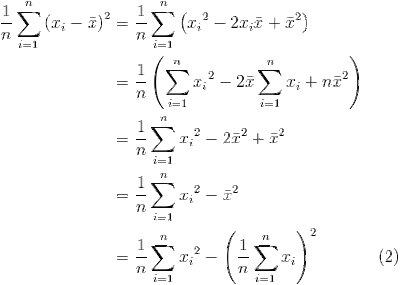
This is using the Blogger generated url in the image tag and has size 400 x 285 pixels.
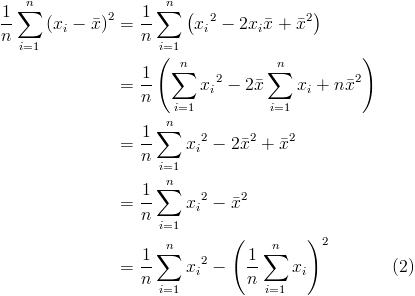
This is using the Picasa generated url and has the original size of 415 x 296 pixels.
Notice how the first image is both smaller and blurry. It seems that Blogger is automatically resizing it. Unfortunately this means a little more work for each equation as it requires generating the link in Picasa and replacing the Blogger generated image tag.
Computing variance
Given a list of n numbers  , the variance is defined as

where  is the arithmetic mean.

Expression 1 stated in words is the average squared difference of each data point from the mean. Implemented as an algorithm, this requires two passes over the data set. The first to calculate the mean and the second to sum the squared differences.
Let's derive the more commonly used expression for variance.
This only requires a single pass over the data set, computing the incremental sum of the values and the incremental sum of their squares. However, if the terms in the subtraction are large and close enough, catastrophic cancellation can occur. Essentially the precision of the floating point representation is exceeded, yielding unacceptable results. See Algorithms for calculating variance and Theoretical explanation for numerical results for examples (they are calculating the sample variance which is slightly different). More detailed information on catastrophic cancellation can be found in What Every Computer Scientist Should Know About Floating Point Arithmetic (1991).
A more numerically stable (but computationally expensive) single pass algorithm was published by Knuth in The Art of Computer Programming, volume 2. Define  and
 as the mean and sum of squared differences of the the first n values respectively.
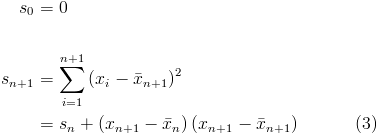
For m > 0 values, the variance is then  .
Derivation of Equation 3
This is really just a more verbose version of one-pass algorithm to compute sample variance. First up is the running mean.
If you think of the mean visually i.e. a horizontal line through the data on a scatter plot, then it is intuitive that the sum of the distances between each point and the mean is zero.
Now define  as the difference of consecutive incremental means, along with a few useful variations.

The pieces are now all in place to derive equation 3.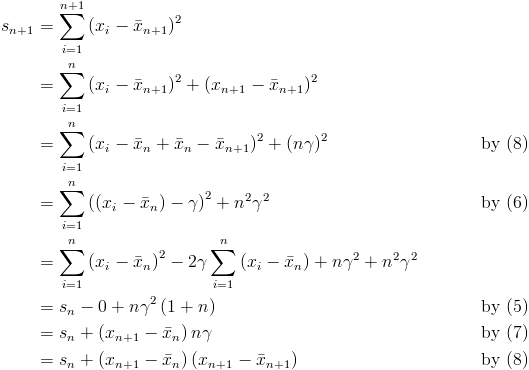
Friday, March 12, 2010
Embeding LaTeX in Blogger
The goal is to include mathematical equations in blog posts. My plan was to create images from the output of MacTeX. Apart from being painfully slow to crop and upload with multiple distinct equations, the LaTeX source would not be contained in the post.
Embedding LaTeX in HTML led me to jsLaTeX. Option 4 from Solutions for JavaScript Hosting in Blogger solved the Blogger hosting issue. After some CSS shenanigans we have Bayes rule right here, right now.
It is easier to write simple equations in the CodeCogs online equation editor first as Blogger preview doesn't seem to execute the JavaScript to render them.
Edit 23/03/2010: No longer using jsLaTeX, see Embedding LaTeX in Blogger take 2.
Friday, February 19, 2010
F# examples talk at BFG
Earlier this week I gave a short talk at the Brisbane Functional Group on F#. The idea was to give an introductory feel for the language by way of some simple examples. The talk was intended to be short so I assumed knowledge of previously discussed idioms such as tuples and curried type signatures.
I took the examples (with permission :-) from the environmental sensing project I work on at MQUTeR. This post is intended as a reference for those who attended rather than a self-contained introduction to F#.
- The
uncurryfunction was first up.let uncurry f (x,y) = f x y
We talked about the syntax of function definition, tuples and type inference in Visual Studio. We inserted the function into F# Interactive (the REPL available in Visual Studio) by highlighting it and pressingALT-Enter. The F# Interactive transcript went something like:val uncurry : ('a -> 'b -> 'c) -> 'a * 'b -> 'cThis lead to a discussion on operators and infix/prefix notation. The post F# Option orElse getOrElse functions should cover that.
> 1 + 2;;
val it : int = 3
> uncurry (+) (1,2);;
val it : int = 3
> (+) 1 2;;
val it : int = 3 - Next was the
|>operator, which has type signature'a -> ('a -> 'b) -> 'b.// Haskell catMaybes
We briefly compared
let catOptions xs = Seq.filter Option.isSome xs |> Seq.map Option.get
let euclidianDist (x1, y1) (x2, y2) = (x1 - x2) ** 2.0 + (y1 - y2) ** 2.0 |> sqrt
let spt' t a =
let m = Math.Matrix.ofArray2D a
allPeaks t m |> removeSmall |> dilate t m |> Math.Matrix.toArray2D
// type signatures
// allPeaks : float -> matrix -> matrix
// removeSmall : matrix -> matrix
// dilate : float -> matrix -> matrix -> matrix
// spt' : float -> float [,] -> float [,]|>with the Haskell$function, which has the type signature(a -> b) -> a -> b. - A quick look at type annotations, pattern matching and Haskell like guards. The example is an implementation of the MATLAB smooth function, which calculates a moving average. We didn't dwell on the entire function, just the relevant parts.
(*
yy = smooth(y,span) sets the span of the moving average to span. span must be odd.

If span = 5 then the first few elements of yy are given by:
yy(1) = y(1)
yy(2) = (y(1) + y(2) + y(3))/3
yy(3) = (y(1) + y(2) + y(3) + y(4) + y(5))/5
yy(4) = (y(2) + y(3) + y(4) + y(5) + y(6))/5
...
*)
let smooth s (a:float []) =
    let n = (s - 1) / 2
    let f i _ =
        let (b, l) = match i with
                     | _ when i < n                  -> (0, i*2+1)
                     | _ when i + n < a.GetLength(0) -> (i-n, s)
                     | _                             -> (i-(a.GetLength(0)-1-i), (a.GetLength(0)-1-i)*2+1)
        Array.sum (Array.sub a b l) / (float l) // TODO try Array.average here
Array.mapi f a - Records are a common kind of data type. The labels are not automatically available as functions like they are in Haskell.
type 'a Rectangle = {Left:'a; Top:'a; Right:'a; Bottom:'a; Width:'a; Height:'a;}The F# overload-o-phone covers our discussion on arithmetic operators. The
let inline cornersToRect l r t b = {Left=l; Top=t; Right=r; Bottom=b; Width=r-l; Height=t-b;}
let inline lengthsToRect l t w h = {Left=l; Top=t; Right=l+w-1; Bottom=t+h-1; Width=w; Height=h;}
let fcornersToRect (l:float) r t b = cornersToRect l r t b // for C#
let left r = r.Left
let right r = r.Right
let top r = r.Top
let bottom r = r.Bottom
let bottomLeft r = (r.Left, r.Bottom)
let width r = r.Width
let height r = r.Height
let inline area r = r.Width * r.Heightinlinekeyword is mentioned in the comments. - Finally we looked at available API documentation. I find that I generally skim API documentation by first looking at function type signatures. The F# PowerPack is a useful library developed by the F# team and the format of the documentation supports my approach.
The F# API documentation was previously in this format. It has now been moved to MSDN and the list of function type signatures is not presented for each module, rendering it almost useless.
Thanks to everyone that participated in the discussion and I hope the talk was interesting.
Friday, February 12, 2010
QOTD
The role of the proof for mathematics is similar to that for orthography or even calligraphy for poetry. A person, who had not mastered the art of the proofs in high school, is as a rule unable to distinguish correct reasoning from that which is misleading. Such people can be easily manipulated by the irresponsible politicians.
-- V.I. Arnold
From: The antiscientifical revolution and mathematics
Thursday, February 4, 2010
Pair Programming again
I saw a local bank advertising a position to promote so called "sustainable software development" practices. These included Pair Programming, TDD, BDD and 100% code coverage.
I have written about Pair Programming before, but it needs re-iterating.
- The value of pair programming is not constant - it is a function of the problem, people and technologies at hand.
- If the problem at hand is not new or not complex the value is often significantly reduced.
- On common information systems / web projects (such as at this company) the problem at hand is often neither new nor complex.
- Therefore, if there is a project rule stating that all production code is to be paired on, the business value of the project will immediately be sub-optimal.
Anecdotally, with skilled developers of reasonable talent and discipline, the pair programming time on these types of projects doesn't need to be above 50%.
